How to Price Handmade Products for Profit: The Complete Artisan Margin Guide
“Handmade products represent creativity, craftsmanship, and countless hours of dedication. However, one of the biggest challenges artisans face is deciding how much to charge for their work. Many sellers calculate only the cost of raw materials while overlooking labour, packaging, shipping, marketplace commissions, and business expenses. This guide explains how to calculate profitable prices while building a sustainable handmade business.”
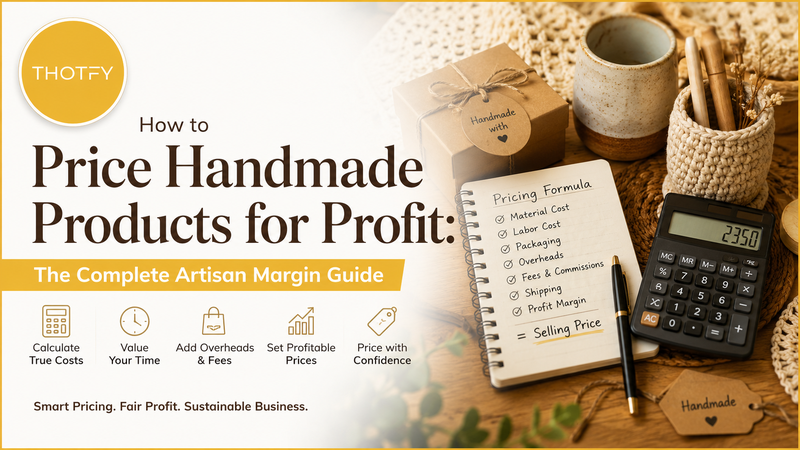
How to Price Handmade Products for Profit (2026 Complete Artisan Pricing Guide)
Pricing is one of the biggest challenges faced by handmade sellers. Many artisans spend hours creating beautiful handmade jewellery, pottery, candles, wooden décor, crochet accessories, resin art, textiles, and personalized gifts, but often fail to earn sustainable profits because they underestimate the true cost of their products. Most creators calculate only the cost of raw materials while forgetting to include labour, packaging, marketing, marketplace commissions, shipping charges, and business overheads. As a result, they work hard but earn very little.
"As the festive season approaches, finding the right way to celebrate relationships and heritage becomes essential. For those seeking meaningful, handcrafted presents that honor traditional craftsmanship, explore our curated selection of artisanal treasures in the Diwali Gifts Collection, featuring thoughtfully designed hampers, home accents, and unique festive finds."
A successful handmade business isn't built on low prices—it's built on smart pricing. Your selling price should reflect the value of your craftsmanship while ensuring your business remains profitable. Whether you are running a small handmade home business or looking to expand your studio, understanding how to sell handmade items with the right pricing strategy will help you cover expenses, grow your brand, and build a long-term business.
Key Takeaways
- Include All Cost Layers: Always account for raw materials, labour, packaging, shipping, overheads, and marketplace fees.
- Pay Yourself First: Your time and expertise are non-negotiable business expenses.
- Avoid Price Wars: Compete on value, craftsmanship, and unique storytelling—not bottom-tier pricing.
- Audit Regularly: Review your catalog pricing sheets every 6–12 months.
- Bake Profit in Upfront: Treat your business profit as a separate entity from your personal labour wage.
"The biggest mistake handmade sellers make isn't creating beautiful products—it's selling them without calculating their true value."
Why Pricing Matters
Your pricing affects every aspect of your business. It determines your profitability, brand perception, customer trust, and future growth. Products priced too low often create the impression of lower quality, while products priced too high without a clear value proposition may struggle to sell. The goal is to find a balance where customers see value, and your business earns healthy profits.
Good pricing allows you to:
- Cover all business and operational costs seamlessly.
- Pay yourself fairly for your physical labor, time, and creative expertise.
- Reinvest in professional equipment, better tools, and higher-grade raw materials.
- Build a sustainable, scalable business model.
- Position and grow your brand confidently in a competitive digital space.
Step-by-Step Production Cost Breakdown
To build an accurate pricing system for your studio, evaluate your costs systematically across five core layers:
Step 1: Calculate Material Costs
Calculate the exact cost of every raw component required to craft a single finished unit.
Artisan Note: Never ignore micro-expenses like custom stickers, interior tissue paper, care tags, ribbons, or protective bubble wrap. These small costs compound over large order volumes and must be built into your base math.
Step 2: Calculate Labour Costs
Your personal time has tangible financial value. Account for hours spent designing, crafting, finishing, and packing. Set a fair hourly wage and multiply it by your production duration:
$$\text{Labour Cost} = \text{Time Required (Hours)} \times \text{Hourly Rate}$$
- Example: 3 Hours Production Time $\times$ ₹300 Hourly Wage = ₹900 Base Labour Cost
Step 3: Include Business Overheads
Running a studio involves general operational expenses not tied to a single item:
- Electricity, studio lighting, and internet utilities
- Studio or workspace rent
- Tool maintenance, wear-and-tear, and machinery updates
- Photography equipment, lighting setups, and backdrops
- E-commerce domain fees, listing costs, and design subscriptions
- Marketing, branding, and social media advertising
To calculate overhead per unit, divide your total monthly operating expenses by your average monthly production volume.
Step 4: Add Marketplace and Transaction Fees
When learning how to sell handmade products online, factor in platform commissions and processing charges before listing items:
- Platform listing and selling commissions
- Payment gateway transaction charges
- Courier shipping labels and weight brackets
- Applicable GST obligations
Step 5: Decide Your Profit Margin
Your profit is entirely separate from your labour cost. Labour pays you for your physical crafting time, whereas profit stays in your business bank account to fund future inventory, marketing, and scaling.
The Master Handmade Pricing Formula
$$\text{Selling Price} = \text{Material} + \text{Labour} + \text{Overheads} + \text{Marketplace Fees} + \text{Shipping} + \text{Desired Profit}$$
Research Competitors Wisely
Competitor research offers helpful benchmarks, but avoid blindly copying another studio's prices. Evaluate these attributes side-by-side:
BenchmarkQuestions to AskMaterial GradeAre they using solid hardwood and eco-dyes, or synthetic composites?Design ComplexityDoes the item require slow, specialized hand techniques?Packaging & PresentationIs it delivered in branded gift packaging or basic poly mailers?Brand Story & ImageryIs the item photographed in high-definition lifestyle settings?Delivery & ExperienceHow efficiently and securely do packages arrive at the destination?
Avoid These Common Pricing Mistakes
- Charging Only for Materials: Destroys your margins and leaves zero capital to restock inventory.
- Ignoring Personal Labour: Treating your crafting hours as free labor leads directly to creative burnout.
- Forgetting Packaging Details: Custom boxes, cards, and tissue add up—include them.
- Underestimating Weight & Shipping: Fragile or bulky items require extra packaging that alters courier tiers.
- Ignoring Platform Commissions: Platform transaction fees will erode your personal take-home pay if not planned for.
- Offering Constant Discounts: Frequent price cuts diminish the perceived luxury and value of handmade items.
- Failing to Update Prices: Failing to adjust prices as raw material, transport, or platform costs rise erodes margins over time.
When Should You Increase Your Prices?
Audit your active pricing catalog every 6–12 months, or immediately upon experiencing any of these signals:
- Supplier Rate Hikes: Your raw material or component suppliers increase their rates.
- Order Backlogs: Demand exceeds your manual production capacity.
- Skill Evolution: Your finishing quality, production speed, and design mastery reach higher standards.
- Brand Equity Growth: Stronger social authority allows you to command premium positioning.
- Platform Rate Changes: Marketplace commissions or shipping logistics adjust upward.
Practical Ways to Boost Margins (Without Raising Retail Prices)
- Bulk Procurement: Buy yarn, wood blanks, wax blocks, or packaging materials in higher volumes to lower cost-per-unit.
- Minimize Waste: Plan cuts, molds, and patterns carefully to extract maximum units per material batch.
- Batch Production: Group similar workflows together (e.g., sanding on Monday, assembling on Tuesday) to reduce setup time.
- Standardize Shipping Boxes: Use uniform box dimensions to streamline bulk purchasing and logistics tiers.
- Curate Value Sets: Combine complementary pieces into bundled gift sets to raise average order value (AOV).
Start Selling Your Craft on Thotfy
Once you've developed a profitable pricing strategy, the next step is finding the best website to sell handmade items. The Thotfy Catalogue connects independent creators directly with buyers looking to buy handmade products online and support authentic craftsmanship.
If you are wondering how to sell handmade items or scale a handmade home business, Thotfy provides an easy-to-use platform designed for independent creators, artisans, and small creative businesses across India.
Why Sell Handmade Products Online with Thotfy?
- Dedicated Handmade Marketplace: A curated platform exclusively built to sell handicrafts online, sell handmade jewellery, sell art online India, and showcase artisan goods.
- Value-Driven Audience: Connect with customers who actively seek out and appreciate authentic artisan stories rather than cheap mass-produced alternatives.
- Simple Seller Onboarding: An intuitive dashboard that makes it simple to list products, manage orders, and track your store's growth.
- Transparent Fee Structure: Keep more of your hard-earned profits with fair marketplace commissions and secure payment pipelines.
- Build Your Independent Brand: Gain the marketing exposure needed to transition your studio from a local hobby into a recognized national brand.
Stop losing your hard-earned margins to high-commission platforms. Become a Verified Seller on Thotfy Today and discover the easiest way to sell handmade products online!
Frequently Asked Questions (FAQs)
1. How do I calculate the price of a handmade product?
Combine raw material costs, direct labor costs (hours $\times$ wage), allocated studio overheads, platform transaction fees, shipping expenses, and your net business profit margin.
2. Should I include labour costs if I work from home?
Yes. Your time, creative skill, and physical craftsmanship are valuable assets. Excluding labor costs means working for free and funding a hobby rather than running a business.
3. What profit margin is ideal for handmade products?
While general artisans target net profit margins between 20% and 40%, boutique brands and luxury creators often maintain markups of 50% to 70% relative to material costs to absorb promotional offers and marketing expenses.
4. Should packaging costs be included in the product price?
Yes. Every physical item delivered—including shipping boxes, interior tissue paper, branded labels, thank-you cards, and bubble wrap—is a direct production cost.
5. How often should I review my public product prices?
Audit pricing sheets every 6 to 12 months, or immediately when raw material prices, marketplace fees, or shipping rates change.
Related Reads & Resources
Continue building and scaling your studio with these resources:
- How to Build a Successful Handmade Business in India
Learn how to choose your niche, map target demographics, market effectively, and build sustainable revenue streams. - Best Handmade Marketplaces in India
Compare top online channels, seller features, commission structures, and platform reach. - Best Marketplaces for Artisans: Where to Sell Handmade Crafts Online
An in-depth review of top platforms for selling jewellery, home decor, woodcrafts, ceramics, and textiles. - Top Marketplaces for Handmade Crafts in India – 2026 Guide
A guide to navigating marketplace compliance, UIN/GST options, and seller onboarding in 2026.